# StakeUp
## Overview
StakeUp Protocol, developed by the Blueberry Foundation, is a composability layer built on top of Circle's `USDC` and Bloom Protocol's `Bloom-v2` , creating an automated lending vault for `USDC` and `TBY`s. This allows permissionless lenders(1) to loan `USDC` to permissioned borrowers within the Bloom system, who can only use these loans to purchase tokenized 'tracker certificates' replicating the price movements of US Treasury Bills. This closed-loop system aims to address the challenge of accessing yield from US Treasury bills.
Additionally, RWAs in DeFi face integration and utility issues due to KYC-mandated procedures and non-KYC nature across the majority of DeFi protocols. StakeUp Protocol's product structure offers significant commercial reach, enabling it to be offered as a stable asset (`stUSDC`), a fixed-income product or a low-risk savings account in various emerging market regions with currency instability, providing stable yields and currency hedging in an easy-to-use product backed up by the most liquid market in tradFi.
{% hint style="info" %}
(1) Restricted geolocation are unable to participate
{% endhint %}
# Current Problem
A significant challenge in the DeFi is accessing yield derived from US Treasury bills in a permissionless manner. Additionally, the majority of today’s RWAs face obstacles in on-chain integration, requiring thorough KYC procedures and limiting assets to isolated DeFi products (where you cannot have pools of non KYC’ed funds integrated with KYC’ed funds), reducing their utility.
The public good, `Bloom-v2`, addresses the KYC and access issues to on-chain products deriving from US Treasuries, but still fails at fully being able to integrate within DeFi due to the production of multiple short date tokens. This makes having sufficient market depth nearly impossible creating another bottleneck within the quest to find the perfect on-chain DeFi Rwa T-bill product.
# Our Solution
A cross-border solution for DeFi and TradFi markets.
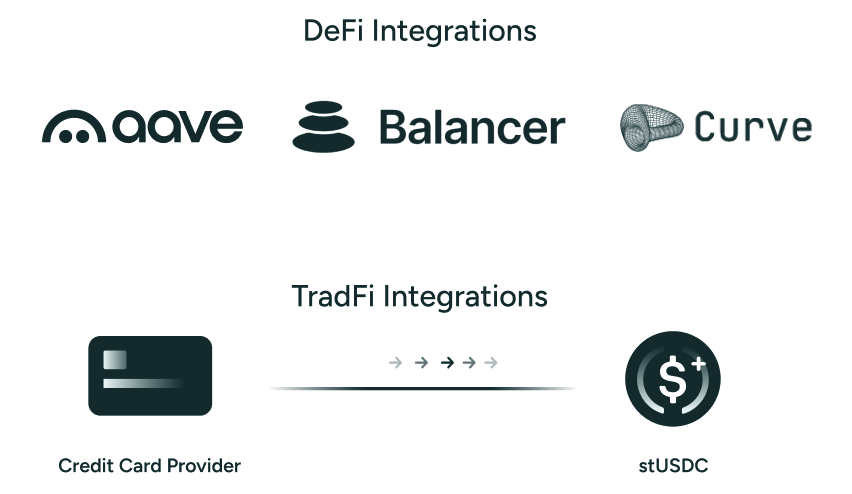
StakeUp's product structure offers greater commercial reach than competitors, facilitating cross-border integrations between TradFi and DeFi markets, and unrestricted cross-integrations within DeFi, creating more global liquidity without violating any global guidelines for traditional and crypto markets. This enables integrations of `stUSDC` as a low-risk savings account or as a currency hedge product offering a secure and liquid yield, particularly suitable for emerging markets.
The composability issue of `Bloom-v2` is also solved by `stUSDC` acting as an auto-compounding wrapper around `Bloom-v2`, thus allowing users to gain all the benefits of lending within the Bloom system along with an improved user-experience and increased potential for deep liquidity depth across various DeFi ecosystems.
# Underlying Backing
StakeUp USDC, or `stUSDC` for short, is backed 100% on-chain by `USDC` and `TBY`s within the Arbitrum instance of `stUSDC`.
To view the live backing of `stUSDC` visit [stakeup.finance/backing](https://docs.stakeup.finance/protocol/www.stakeup.finance/backing).
# Ecosystem Mechanics
The StakeUp ecosystem
# Mint & Redeem
## Mint
Anyone who holds `TBY`s or `USDC` can mint `stUSDC` at a ratio of 1:1 of the value of the deposit token.
`USDC` lending deposits will automatically be lent in the underlying `Bloom-v2` system
`TBY` receipts will be held within the `stUSDC` contract and automatically re-lent into following loans.
## Redeem
Redemptions allow users to redeem their `stUSDC` for `USDC` 1:1. If there is not enough `USDC` liquidity within the contract the user must wait for the next batch of `TBY`s to mature and convert into available `USDC`.
If your redemption cannot be processed and you want to access `USDC` Immediately you can visit a supported DEX or CEX.
# stUSDC
Staked USDC is an rebasing auto-compounding LST for Circle's USDC and Bloom TBYs
## stUSDC vs wstUSDC
There are two versions of StakeUp stTokens, namely stUSDC and wstUSDC. Both are fungible tokens but they reflect the accrued yield differently.
## stUSDC
The token's yield is updated every `24 hours` through the `poke` function and rebases constantly as the previous day's yield is dripped to users. A user is able to redeem their `stUSDC` at a rate 1:1 to `USDC`
{% hint style="warning" %}
For users not familiar with rebasing tokens:
* Token balances will change according to the amount of yield accumulated within the system.
{% endhint %}
## wstUSDC
Provides an alternative to the rebasing version of `stUSDC`. It has a static balance by representing the share that a user has in the system. At any given time, anyone holding wstUSDC can convert any amount of it to stUSDC at a fixed rate, and vice versa. The rate is the same for everyone at any given moment. This method allows for enhanced composability across DeFi.
{% hint style="warning" %}
For users not familiar with rebasing tokens:
* Due to the fact that `wstUSDC` is non-rebasing, the user's balance while holding the token will remain static and value accrual be reflected in the exchange rate of the token.
{% endhint %}
## Wrapping
Users can wrap their `stUSDC` token by calling `wstUSDC::wrap` . The conversion is based on the current exchange rate, which reflects the total value of `stUSDC` in circulation.
## Unwrapping
Users can unwrap their `wstUSDC` token by calling `wstUSDC::unwrap` . The conversion is based on the current exchange rate, which reflects the total value of `stUSDC` in circulation.
## Fees
There is a 10% performance fee on yield generated within `stUSDC`. This fee is paid fully to the stakers of the SUP token within the StakeUp Protocol.
10% Performance Fee
# Staking
## Overview
StakeUp Protocol generates revenue from the performance fees paid by `stUSDC` .
There is a 10% performance fee that is distributed to all stakers of `SUP` within the `StakeUpStaking` contract on Arbitrum.
# SUP
## Overview
SUP is the token representing the StakeUp Protocol. The token can be staked to earn 100% of the fees generated from `stUsdc` in the system. If you do not wish to stake SUP you can also utilize the token throughout any DeFi ecosystem.
## Tokenomics
SUP Tokenomics
### Community Distribution
| Category | Percent of Total Supply |
| --------------------------------- | ----------------------- |
| Launch Mint Partners | 3.75% |
| First $50M Supply Minted | 5% |
| Curve Pool 1 (`stUSDC`/`?)` | 20% |
| Curve Pool 2 (`wstUSDC`/`wstETH`) | 10% |
| Curve Pool 3 (`wstUSDC`/`SUP`) | 5% |
| Bloom Market Makers | 3% |
| Airdrop | 1% |
| Poke Rewards | 1% |
# Omni-chain Functionality
## Overview
All tokens within the StakeUp Protocol are built on top of LayerZero's OFT omnichain token standard. This allows for easy transfers between chains without the need of a third party bridge.
## Launch Chains
* Arbitrum
* Base
* Linea
* Mainnet
* Optimism
### Coming Soon
* Aptos (Date: TBD)
* Botanix (With their mainnet launch)
* Camp (With their mainnet launch)
* Movement (Date: TBD)
* Plume (With their mainnet launch)
* Solana (Date: TBD)
# Smart Contracts
Coming soon...
# Tokens
There are three major token contracts that exist within the StakeUp ecosystem. Each token contains a full feature instance deployed on Arbitrum and a "Lite" instance deployed on all other networks.
{% hint style="info" %}
SUP is not included within the technical docs due to the absence of unique logic for users outside of normal ERC20 and LayerZero OFT standards.
{% endhint %}
# stUsdc
## Overview
Staked USDC is an rebasing auto-compounding LST for Circle's USDC and Bloom TBYs. The interface below is only available for the Arbitrum deployment of the protocol.
## Contract API
### `depositTby`
```solidity
function depositTby(uint256 id, uint256 amount) external returns (uint256 amountMinted);
```
Deposit a specified `amount` of `TBY`s to mint `stUsdc`.
### `depositAsset`
```solidity
function depositAsset(uint256 amount) external returns (uint256 amountMinted);
```
Deposit a specified `amount` of `underlyingToken` to mint `stUsdc`.
### `redeemStUsdc`
```solidity
function redeemStUsdc(uint256 amount) external returns (uint256 underlyingAmount);
```
Redeem `stUsdc` in exchange for `underlyingTokens`
### `poke`
```solidity
function poke(LzSettings calldata settings) external;
```
Invokes the auto stake feature as well as updates the value accrual.
### `wstUsdc`
```solidity
function wstUsdc() external view returns (IWstUsdc);
```
Returns the `wstUsdc` contract instance.
### `asset`
```solidity
function asset() external view returns (IERC20);
```
Returns the `underlyingToken` contract instance.
### `stakeUpStaking`
```solidity
function stakeUpStaking() external view returns (IStakeUpStaking);
```
Returns the `StakeUpStaking` contract instance.
### `performanceBps`
```solidity
function performanceBps() external view returns (uint256);
```
Returns the performance Bps variable.
### `lastRedeemedTbyId`
```solidity
function lastRedeemedTbyId() external view returns (uint256);
```
Returns the last redeemed `tbyId`.
### `globalShares`
```solidity
function globalShares() external view returns (uint256);
```
The total shares of `stUSDC` tokens in circulation on all chains.
# stUsdcLite
## Overview
`stUsdcLite` is a minimal implementation of `stUsdc` that will be deployed on all blockchains except for Arbitrum. It will still accrue the same yield and rebase just like the full instance on Arbitrum. The only difference is that liquidity is not stored within this instance and to deposit and redeem users must either bridge back to Arbitrum or interact with one of our partnered chain abstraction providers. (More details on this to come).
## Contract API
### `transferShares`
```solidity
function transferShares(address recipient, uint256 sharesAmount) external returns (uint256);
```
Transfers `sharesAmount` of `stUsdc` from `msg.sender` to the `recipient`.
### `transferSharesFrom`
```solidity
function transferSharesFrom(address sender, address recipient, uint256 sharesAmount) external returns (uint256);
```
Transfers `sharesAmount` of `stUsdc` from `sender` to the `recipient`.
### `totalUsd`
```solidity
function totalUsd() external view returns (uint256);
```
Returns the total usd value allocated for the given deployment instance of `stUsdc`.
### `totalShares`
```solidity
function totalShares() external view returns (uint256);
```
Returns the total number of shares for the instance of `stUsdc`.
### `sharesOf`
```solidity
function sharesOf(address account) external view returns (uint256);
```
Returns the amount of shares owned by an `account`.
### `sharesByUsd`
```solidity
function sharesByUsd(uint256 usdAmount) external view returns (uint256);
```
Returns the number of shares corresponding with a given `usdAmount`.
### `usdByShares`
```solidity
function usdByShares(uint256 sharesAmount) external view returns (uint256);
```
Returns the amount of USD that corresponds with a given `sharesAmount`.
### `rewardPerSecond`
```solidity
function rewardPerSecond() external view returns (uint256);
```
Returns the `rewardPerSecond` of yield that is being distributed to token holders over the `24 hour` duration following rate updates.
### `lastRateUpdate`
```solidity
function lastRateUpdate() external view returns (uint256);
```
Returns the last time that the rate was updated
### `lastUsdPerShare`
```solidity
function lastUsdPerShare() external view returns (uint256);
```
Returns the `usdPerShare` value at the time of the last rate update
### `totalUsdFloor`
```solidity
function totalUsdFloor() external view returns (uint256);
```
Returns the total USD value of the protocol, not including any yield that is set to drip out with `rewardPerSecond`.
### `keeper`
```solidity
function keeper() external view returns (StakeUpKeeper);
```
Returns the instance of the `StakeUpKeeper` contract, which is a LayerZero OApp that relays rate updates from the liquidity hub chain to all other blockchain instances.
# wstUsdc
## Overview
The Wrapped non-rebasing version of `stUsdc`. The interface below is only available for the Arbitrum deployment of the protocol.
## Contract API
### `depositAsset`
```solidity
function depositAsset(uint256 amount) external returns (uint256 amountMinted);
```
Mint `wstUsdc` directly by depositing `underlyingAssets` .
### `depositTby`
```solidity
function depositTby(uint256 id, uint256 amount) external returns (uint256 amountMinted);
```
Mint `wstUsdc` directly by depositing a specific `TBY` `id` .
### `redeemWstUsdc`
```solidity
function redeemWstUsdc(uint256 wstTBYAmount) external returns (uint256 assetsRedeemed);
```
Redeem `wstUsdc` for `underlyingAssets`.
# wstUsdcLite
## Overview
`wstUsdcLite` is a minimal implementation of `wstUsdc` that will be deployed on all blockchains except for Arbitrum. If users on another chain need to deposit and redeem they must either bridge back to Arbitrum or interact with one of our partnered chain abstraction providers. (More details on this to come).
## Contract API
### `wrap`
```solidity
function wrap(uint256 stUsdcAmount) external returns (uint256 wstUsdcAmount);
```
Wraps `stUsdc` into `wstUsdc`.
### `unwrap`
```solidity
function unwrap(uint256 wstUsdcAmount) external returns (uint256 stUsdcAmount);
```
Unwraps `wstUsdc` and returns `stUsdc` to the user.
### `wstUsdcByStUsdc`
```solidity
function wstUsdcByStUsdc(uint256 stUsdcAmount) external view returns (uint256);
```
Return the amount of `wstUsdc` for a given `stUsdcAmount`.
### `stUsdcByWstUsdc`
```solidity
function stUsdcByWstUsdc(uint256 wstUsdcAmount) external view returns (uint256);
```
Return the amount of `stUsdc` for a given `wstUsdcAmount`.
### `stUsdcPerToken`
```solidity
function stUsdcPerToken() external view returns (uint256);
```
Returns the amount of `stUsdc` per `wstUsdc`.
### `tokensPerStUsdc`
```solidity
function tokensPerStUsdc() external view returns (uint256);
```
Returns the amount of `wstUsdc` for one `stUsdc`.
### `stUsdc`
```solidity
function stUsdc() external view returns (IStUsdc);
```
Returns the `stUsdc` token instance.
# LayerZero OFT
### `send`
```solidity
/**
* @dev Executes the send operation.
* @param _sendParam The parameters for the send operation.
* @param _fee The calculated fee for the send() operation.
* - nativeFee: The native fee.
* - lzTokenFee: The lzToken fee.
* @param _refundAddress The address to receive any excess funds.
* @return msgReceipt The receipt for the send operation.
* @return oftReceipt The OFT receipt information.
*
* @dev MessagingReceipt: LayerZero msg receipt
* - guid: The unique identifier for the sent message.
* - nonce: The nonce of the sent message.
* - fee: The LayerZero fee incurred for the message.
*/
function send(
SendParam calldata _sendParam,
MessagingFee calldata _fee,
address _refundAddress
) external payable virtual returns (MessagingReceipt memory msgReceipt, OFTReceipt memory oftReceipt);
```
When bridging any OFT compatible token in the StakeUp ecosystem, `stUsdc` or `SUP`, the `send` function accomplishes this without the need of extra third party bridges.
# StakeUpStaking
## Overview
`StakeUpStaking` is a smart contract that allows users to stake `SUP` tokens in order to receive fees generated from `stUsdc`.
## Contract API
### `stake`
```solidity
function stake(uint256 stakeupAmount) external;
```
Stake `SUP` tokens in the staking contract to earn `stUsdc` rewards.
### `unstake`
```solidity
function unstake(uint256 stakeupAmount, bool harvestRewards) external;
```
Unstake `SUP` tokens from the staking contract.
### `harvest`
```solidity
function harvest() external;
```
Claim all `stUsdc` rewards accrued by the `msg.sender`
### `getStakeUpToken`
```solidity
function stakupToken() external view returns (IStakeUpToken);
```
Returns the SUP token instance.
### `getStUsdc`
```solidity
function stUsdc() external view returns (IStUsdc);
```
Returns the `stUsdc` token instance.
### `claimableRewards`
```solidity
function claimableRewards(address account) external view returns (uint256);
```
Returns the amount of claimable rewards available for an `account` in terms of `stUsdc`.
### `totalStakeUpStaked`
```solidity
function totalStakeUpStaked() external view returns (uint256);
```
Returns the total amount of `SUP` staked within the staking contract.
### `getRewardData`
```solidity
function rewardData() external view returns (RewardData memory);
```
Returns the global `RewardData` struct for the staking contract.
```solidity
/**
* @notice Data structure containing information pertaining to a reward period
* @dev All rewards are denominated in stTBY shares due to the token's rebasing nature
* @param index The last index that the rewards were updated
* @param lastShares The last shares balance of rewards available in the contract
*/
struct RewardData {
uint128 index;
uint128 lastShares;
}
```
### `getUserStakingData`
```solidity
function userStakingData(address account) external view returns (StakingData memory);
```
Returns `StakingData` for a specific `account`.
```solidity
/**
* @notice Data structure containing information pertaining to a user's stake
* @dev All rewards are denominated in stTBY shares due to the token's rebasing nature
* @param amountStaked The amount of STAKEUP tokens currently staked
* @param index The last index that the users rewards were updated
* @param rewardsAccrued The amount of stTBY rewards that have accrued to the stake
*/
struct StakingData {
uint256 amountStaked;
uint128 index;
uint128 rewardsAccrued;
}
```
### `getLastRewardBlock`
```solidity
function lastRewardBlock() external view returns (uint256);
```
Returns the last block of the global reward data.
# SupVesting
## Overview
Within `StakeUpStaking` contributor and investor token allocations are held allowing users to have their `SUP` tokens staked and generating rewards while they are in the middle of vesting.
## Contract API
### `getAvailableTokens`
```solidity
function availableTokens(address account) external view returns (uint256);
```
Return the amount of tokens currently available to withdraw from the vesting contract.
### `claimAvailableTokens`
```solidity
function claimAvailableTokens() external returns (uint256);
```
Claim and withdraw all tokens that have completed vesting.
### `getCurrentBalance`
```solidity
function currentBalance(address account) external view returns (uint256);
```
Returns the amount of `SUP` that are within the vesting portion of `StakeUpStaking` for a given `account`, vested and locked.
# wstUsdcBridge
## Overview
The canonical bridge for `wstUsdc` that will be deployed on all networks.
## Contract API
### `bridgeWstUsdc`
```solidity
function bridgeWstUsdc(
uint32 dstEid,
bytes32 destinationAddress,
uint256 wstUsdcAmount,
LzSettings calldata settings
) external payable returns (LzBridgeReceipt memory bridgingReceipt)
```
Bridges `wstUsdc` to the destination chain, designated by its `dstEid`.
### `getStUsdc`
```solidity
function stUsdc() external view returns (address)
```
Returns the address of `stUsdc` .
### `getWstUsdc`
```solidity
function wstUsdc() external view returns (address)
```
Returns the address for `wstUsdc`.
### `getBridgeByEid`
```solidity
function bridgeByEid(uint32 eid) external view returns (address)
```
Returns the address of the `wstUsdc` bridge contract for the given endpoint Id, `eid`.
# StakeUpErrors
Below are a list of error codes within the Bloom ecosystem.
```solidity
// =================== Staking ===================
/// @notice Emitted if the staking is locked due to a user depositing less than 24 hours ago
error Locked();
// =================== Curve Gauge Distributor ===================
/// @notice Emitted if the caller tries to seed the gauges to early
error TooEarlyToSeed();
/// @notice Emitted if the reward allocation is not met
error RewardAllocationNotMet();
/// @notice Emitted if the contract is not initialized
error NotInitialized();
// ========================= Staking ===========================
// @notice Token amount is 0
error ZeroTokensStaked();
// @notice User has no current stake
error UserHasNoStake();
// @notice User has no rewards to claim
error NoRewardsToClaim();
// ========================= Layer Zero ===========================
/// @notice If the LZ Compose call fails
error LZComposeFailed();
/// @notice If the originating OApp of the LZCompose call is invalid
error InvalidOApp();
/// @notice Invalid Peer ID
error InvalidPeerID();
/// @notice Error emmitted if the nonce of an incoming message is not what its suppose to be
error InvalidNonce();
/// @notice Error emmitted if the msg.value is less than the fee
error InvalidMsgValue();
// ========================= SUP Token ===========================
/// @notice Amount being minted is greater than the supply cap
error ExceedsMaxSupply();
/// @notice Invalid recipient, must be non-zero address
error InvalidRecipient();
// ========================= StUsdc Token ===========================
/// @notice Error emitted if the asset does not match the BloomPool's asset
error InvalidAsset();
/// @notice Insufficient balance
error InsufficientBalance();
/// @notice TBY redeemable
error RedeemableTbyNotAllowed();
/// @notice Keepers are not allowed for this deployment of stUsdc
error KeepersNotAllowed();
/// @notice Rate update too often
error RateUpdateTooOften();
// ========================= General ===========================
/// @notice Zero amount
error ZeroAmount();
// @notice The address is 0
error ZeroAddress();
/// @dev Error emitted when caller is not allowed to execute a function
error UnauthorizedCaller();
/// @notice Contract has already been initialized
error AlreadyInitialized();
```
# API
Coming soon...
# SDK
A development SDK for wallet providers, front-end providers, and TradFi institutions created to ease the efforts of integrating stUSDC and StakeUp.
Coming Soon...
# Deployment Addresses
Coming soon...
### Mainnets
Arbitrum
`stUsdc`
`wstUsdc`
`StakeUpToken` (SUP)
`StakeUpStaking`
`wstUsdcBridge`
# Audits
Coming soon...
# TERMS OF SERVICE
# Privacy Policy
# FAQs
## What is stUSDC?
stUSDC is a stablecoin within the Bloom Protocol, backed by TBY (fixed-income debt tokens). stUSDC generates yield from these TBY tokens and adjusts its supply periodically (rebasing) to reflect the accrued interest, maintaining a stable value pegged to its underline.
## What is wstUSDC?
wstUSDC is the wrapped version of stUSDC. Unlike stUSDC wstUSDC has a fixed supply, making it easier to use in various DeFi applications and across multiple blockchain networks without the complications of rebasing.
## What is SUP?
SUP is StakeUp Protocol’s yield bearing Utility token, which allows stakeholders to earn a share of StakeUp protocols fees. Fees are paid out to stakeholders according to thier side of SUP, fees are paid in stUSDC
## How does stUSDC generate yield?
stUSDC generates yield through the underlying TBY tokens, which are 6-month fixed-income debt tokens. These tokens pay a set interest rate, and the yield is distributed to stUSDC holders through the rebasing protocol logic.
## How do I wrap stUSDC into wstUSDC?
To wrap stUSDC into wstUSDC, you interact with the wstUSDC contract. The conversion is based on the current exchange rate between stUSDC and wstUSDC, reflecting the total value of stUSDC. Users will be able to do this on StakeUp and other supported DeFi protocols.
## How do I unwrap wstUSDC back into stUSDC?
To unwrap wstUSDC back into stUSDC you use the wstUSDC contract. The conversion back to stUSDC is based on the current exchange rate at the time of unwrapping.
## What are the benefits of holding stUSDC?
Holding stUSDC allows you to earn yield generated by the underlying TBY tokens. The rebasing mechanism ensures your holdings reflect the accrued interest, maintaining a stable value pegged to the underline asset.
## What are the benefits of holding wstUSDC?
Holding wstUSDC provides a stable and predictable token balance, making it easier to use in multi-chain environments and various DeFi applications. wstUSDC does not undergo rebasing, which simplifies liquidity provision and integration with other protocols.
## Why should I wrap stUSDCinto wstUSDC?
Wrapping stUSDCinto wstUSDC is beneficial for using the asset in DeFi applications and multi-chain integrations where a fixed supply token is more supported and rebasing token are not. It avoids the complexities of rebasing, providing a stable and consistent token balance. In some regions non-rebasing tokens are easier to report on taxes.
## what are the fees?
StakeUp protocol only takes a 10% perfomance fee, there are no other fees.